
DTG Printing on Cotton Garments
Ink printed directly into cotton fibres for the softest finish available. Best on promotional tees rather than workwear, and we will tell you when it is the wrong choice.
cotton only, this is the hard limit
minimum order
days under 100 pcs, 3 to 7 on bulk
What DTG Is Actually For
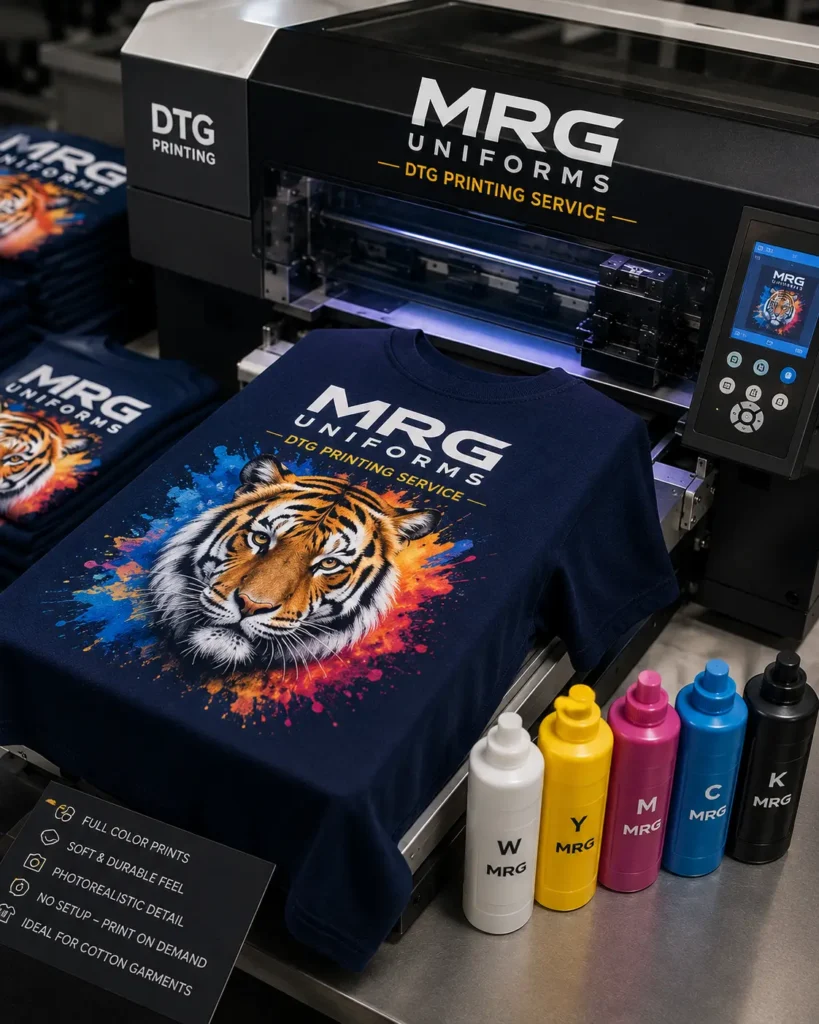
DTG stands for direct to garment. An inkjet printer lays water based ink straight into the fibres rather than onto a film or through a screen, so there is no layer sitting on the surface at all. The result has the softest hand feel of any printing method we offer, closer to a retail graphic tee than to branded workwear.
That softness comes with a narrow range. The ink needs cotton fibres to bond into, so DTG only performs properly on 100 percent cotton. Dark garments also require a pre treatment step before printing. Since most uniforms are poly cotton for durability, DTG has a smaller role here than it does in the fashion t shirt trade, and we are straightforward about that.
Choose DTG when
- The garment is 100 percent cotton
- You want a soft retail feel rather than an obvious print
- Artwork is full colour, photographic or detailed
- The run is small, since there is no setup to spread
- It is promotional or merchandise wear, not daily workwear
Choose something else when
- The garment is poly cotton or polyester, which covers most uniforms
- It will be laundered daily at commercial temperatures
- You are ordering hundreds with a flat colour logo
- The garment is certified flame resistant or high visibility
Why We Recommend It Less Than You Might Expect
Most uniform programmes in the UAE run on poly cotton, because it holds colour and shape through the laundering that uniforms actually get. DTG cannot print on it properly. That single fact rules the method out for the majority of what we make, and no amount of preference changes it.
Where a client asks for DTG on a poly cotton polo, the honest answer is DTF printing instead. It handles the same full colour artwork, works on almost any fabric, and has no minimum either. The trade is a slightly firmer feel, which on a work garment matters far less than a print that will not bond in the first place.
For cotton promotional tees and merchandise, though, DTG is genuinely the nicest result available, and that is where we use it.
At a glance
- Cotton tee, soft feel: DTG
- Any other fabric, full colour: DTF
- Hundreds, flat colours: screen printing
- Daily commercial wash: embroidery
What We DTG Print
Suited garments
Compare methods
- DTF printing, full colour on any fabric
- Screen printing, from 100 pieces
- Logo embroidery, from 10 pieces
- All customization methods
DTG Printing FAQs
Can you DTG print on poly cotton or polyester?
Not properly. The ink needs cotton fibres to bond into, so results on blends are poor and on polyester worse. For those fabrics we use DTF printing, which handles the same full colour artwork on almost anything.
Is DTG better than DTF?
On 100 percent cotton, DTG gives a softer finish because the ink sits in the fibres rather than as a bonded layer. On every other fabric, DTF is better because DTG will not work at all. Fabric decides it, not preference.
What is the minimum order for DTG?
There is no meaningful minimum. Like DTF, there are no screens to make and no setup to spread across a run, so a single garment is viable.
How durable is DTG printing?
It holds up well under normal domestic washing, which suits promotional and merchandise wear. It is not the right choice for garments laundered daily at commercial temperatures, where embroidery lasts considerably longer.
Do dark garments cost more to DTG print?
They require a pre treatment step and a white ink underbase before the colours go down, which adds time to each garment. Light cotton is the most economical DTG substrate.
Can you print photographs with DTG?
Yes. Like DTF it reproduces photographic detail and gradients with unlimited colours at one price, since there are no screens and no per colour charge.
Tell us the garment, not just the method
Send the fabric and the artwork. If DTG is right we will use it, and if it is not we will say which method is and why.