DTF vs Screen Printing
Two very different economics. One has no minimum and no setup per colour, the other gets cheaper the more you order. Here is where each wins.
The Crossover Point Is Around 100 Pieces
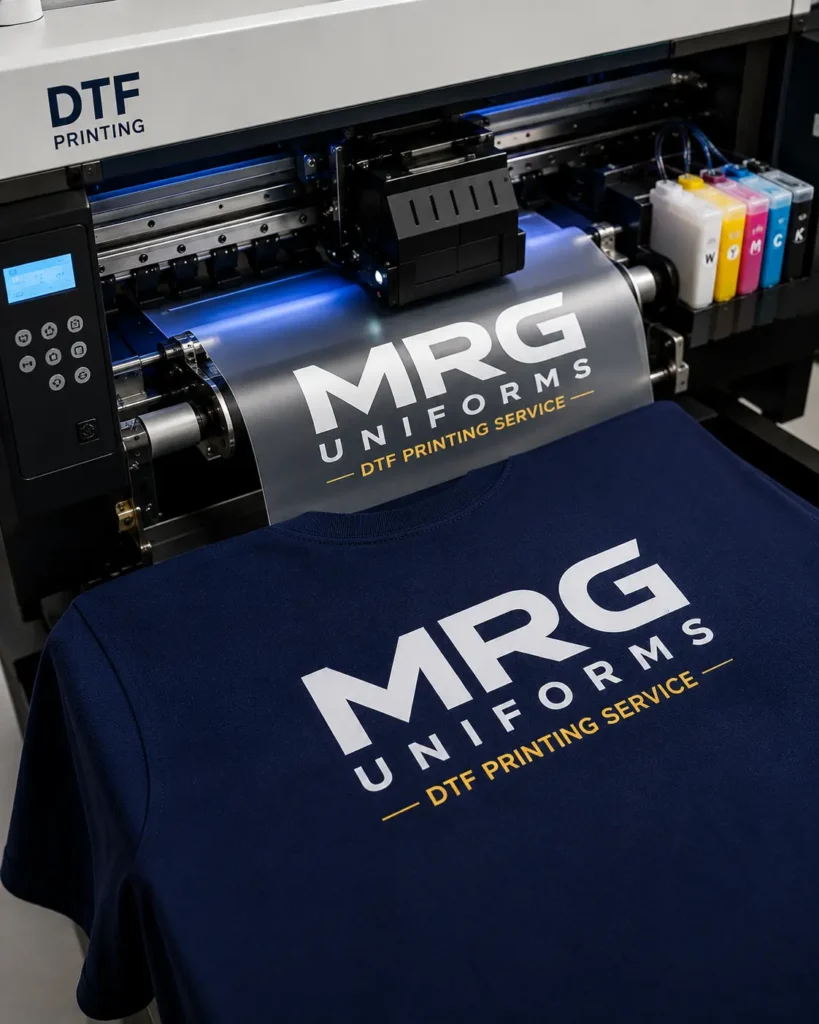
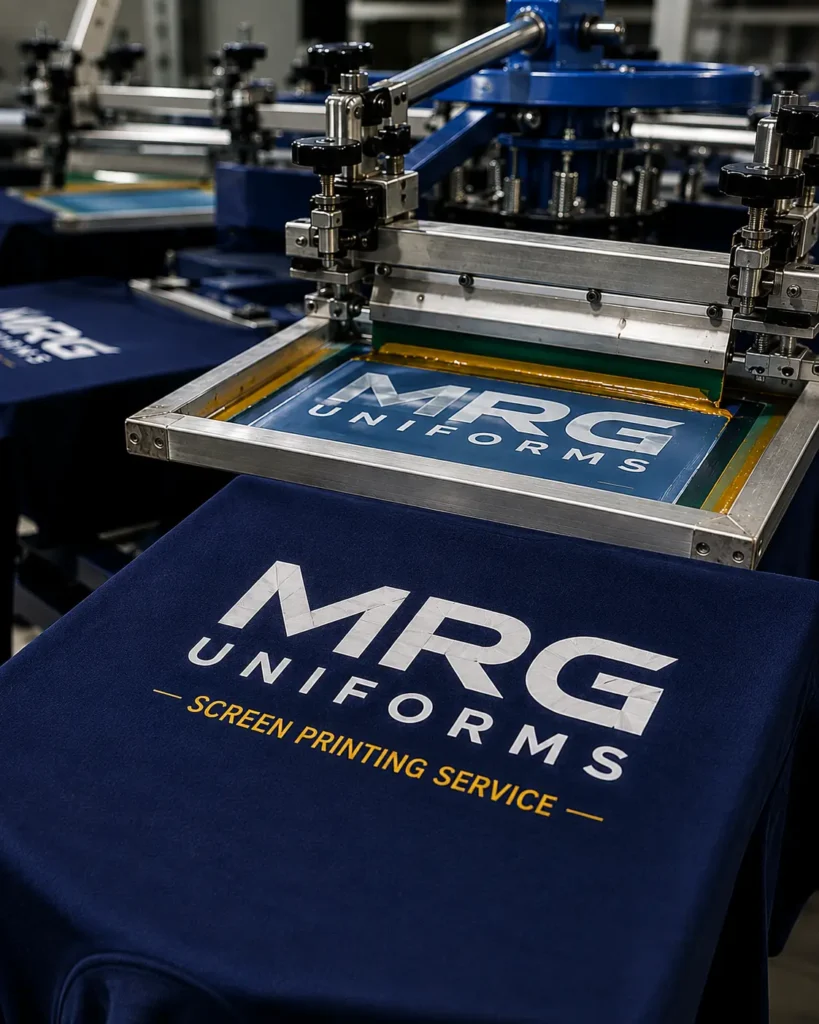
Screen printing needs a separate screen made for every colour in your design, and that setup cost is fixed whether you print twenty garments or five hundred. DTF prints straight to film with no screens at all, so there is nothing to set up and no minimum.
That single difference explains everything else. Below roughly 100 pieces, the screen setup has too few garments to spread across and DTF is cheaper. Above it, screen printing pulls ahead and keeps widening the gap. Our screen printing minimum is 100 pieces for exactly this reason, and DTF has no meaningful minimum at all.
Side by Side
DTF printing
- No minimum, a single sample is viable
- Priced by print area, colours are free
- Photographs, gradients and fine detail all reproduce
- Works on cotton, poly cotton, polyester, blends and technical fabric
- White underbase keeps colours opaque on dark garments
- No dye migration risk on red or navy polyester
- You can feel the transfer sitting on the fabric
- Wears faster than thread under heavy industrial laundering
Screen printing
- 100 piece minimum with us
- Priced per colour, each needs its own screen
- Best on one to four flat colours, not photographic artwork
- Sits best on cotton and poly cotton
- Thinner hand feel than a DTF transfer
- Dye migration risk on dark polyester, countered with low bleed ink and a blocking underbase
- Lowest cost per garment at volume
- Very durable under normal washing
DTF vs Screen Printing at a Glance
Quantity is the deciding factor. Below roughly 100 pieces DTF wins on cost, above it screen printing pulls ahead.
| DTF printing | Screen printing | |
|---|---|---|
| Minimum order | No minimum | 100 pieces |
| Priced by | Print area | Number of colours |
| Setup per colour | None | One screen per colour |
| Full colour artwork | Yes | Limited |
| Maximum print size | A2, 420 x 594 mm | A2, 420 x 594 mm |
| Dark polyester | No dye migration risk | Dye migration risk |
| Feel on garment | Transfer sits on fabric | Thinner hand feel |
| Cost at 500 pieces | Higher per unit | Lowest per unit |
The Fabric Question Most Buyers Miss
On 100 percent polyester, particularly red and navy garments, the fabric dye turns to gas under the heat of the screen printing curing tunnel and bleeds up into the ink. A white print slowly turns pink over the following weeks. It is invisible on delivery day, which is exactly why it reaches so many customers.
We counter it with low bleed inks and a blocking underbase, and we flag the risk before production. But if your garment is dark polyester and the print is light, DTF sidesteps the problem entirely rather than managing it. That is a genuine technical reason to choose DTF even at volumes where screen printing would otherwise be cheaper.
Which to Ask For
Ask for DTF when
- You need fewer than 100 pieces
- The artwork has photographs, gradients or many colours
- The garment is dark polyester or technical fabric
- Different designs are needed within one order
- You are producing a sample or a one off event batch
Ask for screen printing when
- You are ordering 100 pieces or more
- The logo is one to four flat colours
- Garments are cotton or poly cotton
- You want the lowest possible cost per unit
- You prefer a thinner feel on the fabric
If the garment is laundered daily at commercial temperatures, neither is the best answer. Logo embroidery outlasts both, which is why healthcare and hospitality uniforms are almost always stitched. See embroidery vs printing for that comparison.
Read More on Each Method
- DTF printing, no minimum, full colour
- Screen printing, from 100 pieces
- Sublimation printing, for light polyester sportswear
- All customization methods
DTF vs Screen Printing FAQs
Is DTF cheaper than screen printing?
Below about 100 pieces, yes, because screen printing setup has too few garments to spread across. Above that, screen printing becomes cheaper per garment and the gap widens with quantity. Quantity is the deciding factor, not the method itself.
Which lasts longer, DTF or screen printing?
A correctly cured screen print is generally more durable under repeated washing, and it has a thinner feel. DTF holds up well under normal washing but is a bonded layer, so it wears faster under heavy industrial laundering. For daily commercial washing, embroidery outlasts both.
Can both print on dark garments?
Yes. DTF uses a white ink underbase, and screen printing uses an underbase layer too. The difference is on dark polyester, where screen printing carries a dye migration risk that DTF avoids entirely.
Which is better for full colour artwork?
DTF, without question. It reproduces photographs, gradients and unlimited colours at one price. Screen printing charges per colour and cannot reproduce photographic detail, so complex artwork gets expensive and looks worse.
What is the minimum order for each?
Screen printing is 100 pieces with us. DTF has no meaningful minimum, so samples and very small runs are always possible.
Do you sell DTF printers or transfers?
No. We are a uniform manufacturer, not an equipment supplier. We print and press onto garments for businesses across the UAE, either on uniforms we make or on garments you supply.
Send the artwork and the quantity
Those two things decide the method. We will price both where it is close, so you can see the crossover for yourself rather than take our word for it.
Related Guides
Part of our uniform buying guides. See also embroidery vs printing and DTG printing.